

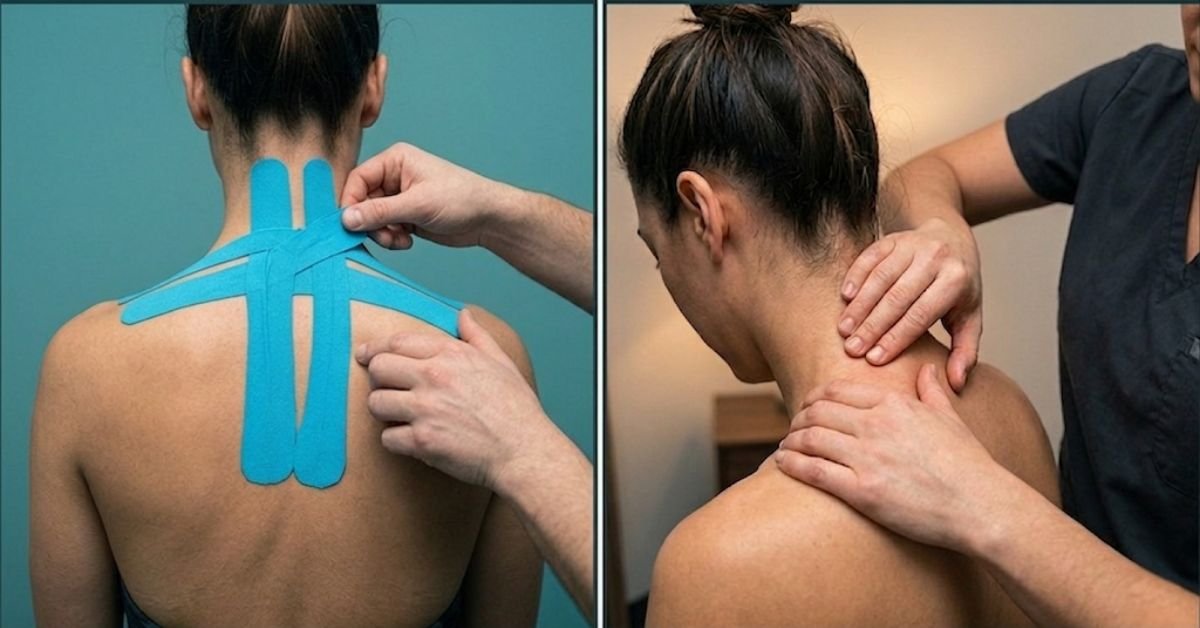
Walk into most sports clinics or chiropractic offices today and you will see both: the colorful strips of kinesiology tape running along athletes’ shoulders, knees, and backs, and the focused manual pressure of trigger point therapy releasing tight, painful muscle knots. They look very different, they work through completely different mechanisms, and yet they are frequently confused or used interchangeably.
They are not interchangeable. K-taping and trigger point therapy serve distinct purposes, work on different tissue targets, and produce their effects through different physiological pathways. Knowing which one applies to your condition, and when combining them makes sense, is the difference between treatment that addresses what is actually wrong and treatment that feels like it should be helping.
At Citrin Chiropractic in St. Louis, both modalities are part of our clinical toolkit, applied with specific indications and integrated into coordinated care plans. Here is exactly how each works, what each is best for, and how we decide which to use.
| Not sure which therapy is right for your condition? Book a consultation at Citrin Chiropractic Center.Call (314) 890-2400 or book your free consultation online. |
K-Taping: What It Does and How It Works
K-TAPING Kinesiology Taping
Kinesiology tape, commonly called K-tape or Kinesio tape, is a thin, elastic therapeutic tape applied in specific patterns directly on the skin over or around the affected area. Unlike rigid athletic tape, which immobilizes joints, K-tape is designed to move with the body while providing a continuous therapeutic stimulus through the skin and underlying tissue.
The primary mechanism of K-taping is mechanical decompression of the superficial tissue. When applied with appropriate tension, the tape lifts the skin microscopically away from the underlying fascia and muscle. This decompression reduces pressure on the mechanoreceptors and nociceptors in the skin, the sensory receptors responsible for pain signaling, and simultaneously improves circulation and lymphatic drainage in the decompressed area.
What K-tape actually does: reduces pain through sensory input modulation, improves local circulation, supports joint proprioception, facilitates or inhibits specific muscle activation patterns depending on application direction, and provides a continuous low-level therapeutic stimulus between clinic visits without restricting movement.
When K-Taping Is the Right Choice
Kinesiology taping produces its best results in specific clinical situations where the primary goal is reducing pain and swelling, supporting a joint or muscle group without restricting motion, or reinforcing a muscle activation pattern that has been disrupted by injury.
- Acute soft tissue injuries in the inflammatory phase, K-tape reduces swelling and pain without compromising the circulation needed for healing
- Joint instability or hypermobility, tape provides proprioceptive feedback that improves joint awareness and reduces re-injury risk without locking the joint
- Postural correction support, cervical and thoracic taping patterns reinforce upright posture and inhibit forward head positioning between adjustments
- Sports injury prevention, taping specific muscle groups before athletic activity facilitates activation or provides protective feedback
- Post-adjustment support, applied after chiropractic adjustment, K-tape helps maintain the corrected position by providing continuous feedback to the surrounding musculature
- Lymphedema and post-injury swelling, specific lymphatic taping patterns improve drainage and reduce edema significantly faster than rest alone
What K-tape does NOT do: it does not release trigger points, break up scar tissue adhesions, or address the underlying muscle hypertonicity that causes chronic pain patterns. It modulates the sensory environment and supports tissue recovery, it does not manually intervene in the tissue itself. This is the critical distinction from trigger point therapy.
Trigger Point Therapy: What It Does and How It Works
TRIGGER POINT Trigger Point Release Therapy
A trigger point is a hyperirritable spot within a taut band of skeletal muscle, a small, electrically active region of contracted sarcomeres that fails to release after the muscle activation that created it. Trigger points are not simply tight muscles. They are discrete, palpable nodules within the muscle fiber that have a characteristic referral pattern, meaning they produce pain not just at the trigger point itself but at a predictable distant site.
The mechanism of trigger point formation involves sustained muscle contraction creating local ischemia, reduced blood flow, in the contracted region. The ischemic tissue releases sensitizing substances including bradykinin, substance P, and inflammatory cytokines that maintain the contraction and produce the hypersensitivity characteristic of active trigger points. Left untreated, trigger points become self-perpetuating: the ischemia maintains the contraction, the contraction maintains the ischemia.
What trigger point therapy actually does: applies sustained, focused mechanical pressure to the trigger point nodule, temporarily increasing local ischemia until the sarcomere units release, then allowing a rush of oxygenated blood into the area that clears the sensitizing substances and breaks the self-perpetuating cycle. The release is often felt as an immediate reduction in both local tenderness and referred pain.
When Trigger Point Therapy Is the Right Choice
Trigger point release therapy is indicated when the primary clinical finding is a palpable taut band with a reproducible referral pattern, and when the referred pain pattern explains symptoms that seem unrelated to the site of tenderness.
- Tension and cervicogenic headaches, suboccipital and upper trapezius trigger points referring pain into the head respond dramatically to focused trigger point release
- Shoulder and rotator cuff pain, infraspinatus, subscapularis, and supraspinatus trigger points produce characteristic shoulder pain and arm referral patterns that do not respond to rest or anti-inflammatories
- Lower back pain with hip or leg referral, quadratus lumborum and gluteus medius trigger points are among the most commonly missed sources of pseudo-sciatica and hip pain
- Jaw pain and TMJ dysfunction, masseter and temporalis trigger points refer pain into the teeth, ear, and jaw in patterns frequently misattributed to dental problems
- Chronic recurring pain that has not responded to other treatments, when pain keeps returning despite adjustment and rest, active trigger points are often the perpetuating factor
- Post-accident muscle guarding, the protective spasm that develops around a whiplash or impact injury frequently creates secondary trigger points that outlast the original injury
The referral pattern principle: the most clinically important thing to understand about trigger points is that the pain you feel is frequently not where the trigger point is. The headache at your temple is a masseter trigger point. The outer hip pain is a gluteus medius trigger point. The arm pain is an infraspinatus trigger point. Treating the site of pain without finding the trigger point source produces temporary relief at best.
When to Use Both Together
In clinical practice, K-taping and trigger point therapy are frequently most effective when used in sequence as part of the same treatment session. The combination addresses both the active pain generator (the trigger point) and the tissue environment that allows it to persist and reform (managed through K-tape’s circulatory and sensory effects).
Here is the sequence that produces the best outcomes at Citrin:
- Trigger point release is performed first, releasing the active trigger point and its referral pattern
- Chiropractic adjustment addresses the joint dysfunction that is often the mechanical perpetuating factor for the trigger point
- K-tape is applied last, supporting the released muscle, improving local circulation to clear the post-release sensitizing substances, and providing continuous proprioceptive feedback to prevent the muscle from immediately returning to its contracted state
This sequence, release, adjust, tape, produces outcomes that are significantly more durable than any single modality alone. The trigger point release addresses the immediate pain generator. The adjustment addresses the structural driver. The tape maintains the gains between sessions.
Condition-by-Condition Guide: Which Therapy Applies
Here is how the decision plays out for the specific conditions we most commonly see at Citrin:
Whiplash and Post-Accident Neck Pain
K-Taping: Applied to cervical paraspinals and upper trapezius to reduce post-injury swelling, support cervical alignment after adjustment, and provide continuous pain-modulating input between visits.
Trigger Point: Releases the suboccipital trigger points producing occipital headaches, and the upper trapezius and levator scapulae trigger points producing referred neck and shoulder pain from the whiplash injury.
Combined: Both in sequence at most sessions, trigger point release first, K-tape applied after adjustment to maintain position and reduce recurrence.
Sports Injuries and Muscle Strains
K-Taping: Primary modality in the acute phase, reduces swelling, supports the injured muscle without restricting sport-specific movement, and can be worn during training to provide feedback during return-to-activity.
Trigger Point: Indicated once the acute phase has passed and palpable trigger points are identified in the injured or compensating muscle groups.
Combined: Common approach for rotator cuff strains, trigger point release of infraspinatus and subscapularis, followed by K-tape to support the shoulder through return-to-sport movement.
Chronic Lower Back Pain
K-Taping: Supportive role, lumbar taping patterns reduce pain during daily activities and improve proprioception in patients with recurrent lower back episodes.
Trigger Point: Primary intervention when active trigger points are identified in quadratus lumborum, gluteus medius, or piriformis, the three most common sources of chronic lower back and hip referral pain.
Combined: Combined for patients with both active trigger points and functional instability, release the trigger points first, tape for daily support and movement feedback.
Tension Headaches and Cervicogenic Pain
K-Taping: Cervical and postural taping applied to reduce forward head load on the cervical extensors and provide ongoing feedback for upright head positioning.
Trigger Point: Primary intervention, suboccipital and upper trapezius trigger point release directly addresses the headache source and produces the most immediate symptom relief.
Combined: Release first for headache reduction, tape afterward to support cervical posture and slow the return of the trigger points between appointments.
Knee and IT Band Injuries
K-Taping: Strong evidence for reducing anterior knee pain and IT band syndrome through specific taping patterns that offload the patella and reduce IT band tension at the lateral condyle.
Trigger Point: Used for active trigger points in the vastus lateralis and TFL (tensor fasciae latae) that perpetuate IT band tightness and lateral knee pain.
Combined: K-tape for structural offloading and pain reduction, trigger point work on TFL and gluteus minimus for the muscle component of the IT band syndrome.
| Clinical note from Dr. Rutherford: As a former competitive baseball player, I used both modalities throughout my playing career without ever being clearly explained why one was used instead of the other on a given day. Understanding the mechanism behind each, and the specific indications, is what separates purposeful clinical treatment from routine application of whatever is available. Every K-tape application and every trigger point session at Citrin has a specific target and a specific goal. |
| Pain that is not responding to standard treatment? Book a consultation, we find what others miss.Call (314) 890-2400 or book your free consultation online. |
Frequently Asked Questions
What does kinesiology taping do?
Kinesiology taping, K-tape, works primarily by lifting the skin microscopically away from the underlying tissue, which reduces pressure on sensory receptors, improves local circulation and lymphatic drainage, and provides continuous proprioceptive feedback to the surrounding musculature. It reduces pain, supports injury recovery, and helps maintain posture and joint positioning between clinic visits. It does not fix trigger points or break up adhesions, that requires manual intervention.
What is trigger point therapy?
Trigger point release therapy applies sustained manual pressure to hyperirritable nodules within muscle tissue, trigger points, that produce both local tenderness and referred pain at predictable distant sites. The sustained pressure temporarily increases local ischemia until the contracted sarcomeres release, allowing oxygenated blood to clear the sensitizing substances that maintain the trigger point. The release typically produces immediate reduction in both the local tenderness and the referred pain pattern.
Can K-tape and trigger point therapy be used together?
Yes, and the combination is often more effective than either alone. The recommended sequence is trigger point release first to address the active pain generator, chiropractic adjustment to correct the structural perpetuating factor, then K-taping applied last to support the released muscle, improve circulation, and provide ongoing sensory feedback that slows the return of the trigger point between sessions.
How long does K-tape stay on?
Properly applied kinesiology tape adheres for three to five days in most patients, remaining effective through showering, light swimming, and normal daily activity. The tape should be removed if it causes skin irritation, itching, or if the adhesion begins to lift significantly. We apply K-tape using skin-appropriate techniques to maximize wear time and minimize skin reaction.
Is trigger point therapy painful?
Trigger point therapy produces a distinctive sensation, the pressure on the trigger point creates a recognizable ache that often reproduces the referred pain pattern the patient knows. This is called the “jump sign” or referral confirmation. Most patients describe it as a good hurt, therapeutic discomfort that they recognize as the source of their pain being addressed. The release that follows is typically felt as immediate relief of both local and referred pain. We calibrate pressure to keep the experience within a therapeutic range.
Which conditions respond best to K-taping?
K-taping produces its strongest results for acute soft tissue injuries with swelling, joint instability or hypermobility requiring proprioceptive support, postural correction between adjustments, IT band syndrome and anterior knee pain, post-whiplash cervical support, and lymphedema management. It is a supportive and sensory modality, most effective when combined with adjustment and trigger point work for conditions that have both a pain generator and a structural component.