

You wake up in the morning, take your first step out of bed, and a sharp pain shoots through the bottom of your heel. By mid-morning it has eased into a dull ache. By evening it is throbbing again. This is the pattern of plantar fasciitis, one of the most common foot complaints we see at our St. Louis office, and one of the most misunderstood.
Most patients who arrive at the clinic with heel pain have already tried the standard advice: rest, ice, arch supports, anti-inflammatory medication, maybe a cortisone injection. Some of them have been dealing with the pain for months. A few have been told the next step is surgery. What almost none of them have been told is that the pain in their foot may not actually be a foot problem at all.
At Citrin Chiropractic Center in St. Louis, our physicians have been treating plantar fasciitis for over 45 years, and the pattern is consistent enough that it is worth stating plainly: in a significant number of cases, the true source of the pain lives higher up the kinetic chain, in the lumbar spine, the pelvis, or the mechanics of how you walk. Treat the foot alone, and the pain comes back. Treat the whole system, and it resolves.
What Plantar Fasciitis Actually Is
The plantar fascia is a thick band of connective tissue that runs from your heel bone to the base of your toes, forming the arch of your foot. It acts as a natural shock absorber, absorbing the force of every step and supporting the arch as you walk, run, and stand. When that tissue is repeatedly overloaded, microscopic tears develop, inflammation sets in, and the result is the sharp, stabbing heel pain that defines plantar fasciitis.
The classic symptoms are unmistakable: pain on the underside of the heel, worst with the first steps in the morning or after sitting for a long time, easing somewhat as you move around, then returning after prolonged standing or activity. Some patients also report pain that radiates along the arch of the foot or a burning sensation in the heel.
What conventional treatment tends to focus on is the tissue itself. Rest reduces the load. Ice reduces the inflammation. Stretching lengthens the shortened fascia. Orthotics support the arch. These interventions help, and for some patients they are enough. But when the pain keeps coming back, or never fully resolves, the reason is almost always that the underlying cause has not been addressed.
The Spinal Connection Most Patients Miss
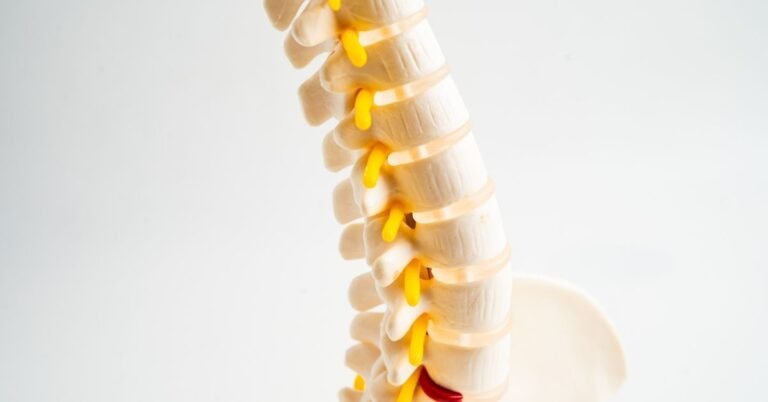
Here is the connection most patients have never had explained to them: the way you walk, the way your foot strikes the ground, the way the load transfers through your leg and into your foot, all of this is governed by the alignment and function of your spine and pelvis. When your lumbar spine, pelvis, or hip mechanics are off, the foot pays the price.
A misaligned pelvis, for example, can cause one leg to function as though it is slightly shorter than the other, altering your gait pattern and concentrating more load on one foot. A subtle rotation in the lower spine changes how the muscles of the leg fire during walking, changing where the pressure lands on the sole of the foot. Even nerve irritation in the lumbar spine, the same irritation that causes sciatica, can produce weakness and altered muscle function in the leg that changes how the foot works with every step.
Any of these upstream problems can overload the plantar fascia and produce heel pain that looks and feels like a pure foot problem. Treating only the foot in those cases is like treating a leaking ceiling without checking the roof. The water keeps coming, no matter how many buckets you empty.
The pattern to remember: if your plantar fasciitis has not responded to rest, stretching, orthotics, or anti-inflammatories after several weeks, the cause is not in your foot alone. Something further up the kinetic chain is driving the overload, and until that upstream problem is corrected, the foot pain will keep coming back.
Chiropractic vs Orthotics vs Surgery
Patients weighing their treatment options for stubborn heel pain generally hear about three main paths. Here is how each one actually compares.
Orthotics and Conservative Foot Care
Custom orthotics, arch supports, night splints, and stretching programs are the standard first-line approach. They work for some patients and are worth trying. The limitation is that they address symptoms and mechanical support at the foot, not the reasons the foot is overloaded in the first place. When they fail, patients are typically told to escalate to injections or surgery, when the correct next step is often to look upstream.
Cortisone Injections
Steroid injections can provide short-term relief for stubborn cases, but they carry real risks. Repeated injections weaken the plantar fascia over time and increase the risk of rupture, and the underlying cause remains untreated. Injections are a symptom-management tool, not a solution.
Surgery
Plantar fascia release surgery is a last-resort option and is not necessary for the vast majority of patients. Recovery is prolonged, results are inconsistent, and the underlying biomechanical drivers of the pain are still not addressed. Before considering surgery, every patient deserves a thorough evaluation of whether their pain has a treatable upstream cause.
Chiropractic Care
Chiropractic evaluation and treatment addresses the whole kinetic chain, spine, pelvis, hip, knee, ankle, and foot, identifying which links are contributing to the overload of the plantar fascia and correcting them together. In our experience at Citrin, this approach resolves plantar fasciitis in patients who have not responded to conservative foot care alone, often within a few weeks of care.
What Treatment Looks Like at Citrin
The first visit for a plantar fasciitis patient is a full biomechanical evaluation, not just a foot exam. Our physicians assess your posture, gait pattern, pelvic alignment, hip and knee mechanics, and lumbar spine function alongside a detailed foot examination. The goal is to identify every link in the chain that is contributing to your pain.
Chiropractic Adjustment
Chiropractic adjustment restores proper motion and alignment to the spinal segments and pelvis that govern how your legs work. For patients whose plantar fasciitis has a spinal driver, this is often the single most important intervention. Adjustments to the foot and ankle joints themselves may also be indicated depending on what the examination reveals. If your lower back has been contributing to the problem, our back pain treatment approach works alongside the foot care.
Soft Tissue Work and Massage Therapy
The plantar fascia itself, along with the calf muscles and the intrinsic muscles of the foot, benefits from targeted soft tissue work. Our medical massage therapy program addresses the fascial restriction that maintains the problem long after the initial inflammation has settled. Trigger point release in the calves is particularly effective for stubborn cases.
Active Rehabilitation
Corrective exercises are essential for lasting recovery. Active rehabilitation at our office focuses on restoring the strength of the intrinsic foot muscles, correcting gait patterns, and building durability in the whole kinetic chain so the pain does not return once treatment ends.
Nerve Involvement
In cases where nerve irritation is contributing to altered muscle function in the leg or foot, we address the root cause at the spinal level. This overlap with disc injury patterns is why a thorough spinal evaluation matters even when the presenting complaint is a foot problem.
Athletes, Standing Workers, and Repeat Sufferers
Certain patients are at higher risk for plantar fasciitis and for repeat episodes. Runners, court-sport athletes, and anyone whose job requires standing all day, teachers, nurses, retail workers, hospitality staff, restaurant workers, live in the highest-risk group. For these patients, the biomechanical evaluation is even more important, because the volume of load their feet handle daily means small alignment problems produce big consequences over time.
Our sports injury treatment approach is designed for exactly this kind of case, patients who need to get back to activity, who cannot rest their feet for weeks at a time, and who need durable results rather than a temporary fix.
Exercises and Stretches to Do Between Visits
Home care is a real part of recovery. The following exercises, when done consistently, complement the in-office care and speed up progress. None of them replace evaluation and treatment, but all of them help.
- Calf stretch against a wall: hold for 30 seconds, three times per side, morning and evening. Tight calves are a major contributor to plantar fascia overload.
- Plantar fascia stretch: sit with one leg crossed over the other, gently pull the toes back toward the shin, hold for 30 seconds, three sets per side.
- Frozen water bottle roll: roll the sole of the foot over a frozen water bottle for 5 to 10 minutes at the end of the day. Combines gentle stretching with anti-inflammatory cooling.
- Toe pickups: pick up small objects (marbles, a towel) with your toes to strengthen the intrinsic foot muscles.
- Short foot exercise: practice actively lifting the arch of the foot without curling the toes. Restores the muscular support of the arch.
Common mistake: only stretching the foot
Most patients focus their home care exclusively on the foot itself. In reality, tight calves, weak hip stabilizers, and stiff ankles all contribute to plantar fasciitis and all need attention. A complete home program includes the whole leg, not just the sole.
When to Seek Care
Not every case of morning heel pain needs professional attention. Mild cases often resolve with rest, ice, and better shoes within a week or two. But if any of the following describe your situation, it is time to be evaluated.
- Heel pain that has lasted longer than two weeks despite home care
- Pain that is affecting your ability to work, exercise, or walk normally
- Sharp morning pain that returns every day, even after months of trying self-care
- Pain that has spread to include the arch, the ankle, or the calf
- Recurring episodes that keep coming back after temporary relief
- Any suggestion that surgery might be next, before agreeing, get a full biomechanical evaluation
Patients drive to our St. Louis office from across the metro area for this care, including from Florissant, Clayton, Maryland Heights, University City, and beyond. Bilingual English and Spanish care is available at every visit. Same-day appointments are the standard.
Frequently Asked Questions
Can a chiropractor really help with plantar fasciitis?
Yes, and often more effectively than foot-only treatment. Chiropractic care addresses the whole kinetic chain, spine, pelvis, hip, and lower leg mechanics, that contributes to overloading the plantar fascia. For patients whose plantar fasciitis is not responding to rest, stretching, or orthotics, chiropractic evaluation frequently identifies the upstream cause that other providers have missed.
How long does it take to see results from chiropractic care for plantar fasciitis?
Most patients notice meaningful improvement within the first two to four weeks of care. Full resolution typically takes six to twelve weeks depending on how long the condition has been present and how much upstream involvement there is. Chronic cases that have been present for many months can take longer but almost always improve with the right approach.
Do I need orthotics if I get chiropractic care?
Sometimes yes, sometimes no. Orthotics support the foot mechanically, which is helpful during the healing phase and for patients whose foot structure genuinely needs support. Our physicians make that recommendation based on your specific case rather than as a universal rule. Many patients do well without orthotics once the upstream problems are addressed.
Is it safe to get chiropractic adjustments if I have plantar fasciitis?
Yes. Chiropractic adjustment is safe and effective for plantar fasciitis when performed by an experienced physician who has thoroughly evaluated your specific case. Adjustments to the spine, pelvis, and lower extremity are directly relevant to the treatment plan, not incidental to it.
Can plantar fasciitis be caused by problems in my lower back?
Yes. Lumbar spine dysfunction, nerve irritation, and pelvic misalignment all change how the leg and foot function during walking. These upstream problems can produce or worsen plantar fasciitis, and treating them is often the missing piece for patients whose heel pain has not responded to foot-only care.
Do I need imaging or an MRI before chiropractic treatment for plantar fasciitis?
Usually not. Plantar fasciitis is a clinical diagnosis based on history and examination, not on imaging. Imaging is reserved for cases where a stress fracture, heel spur complication, or other structural problem is suspected. Our physicians will let you know if imaging is indicated for your specific case.
Will my insurance cover chiropractic treatment for plantar fasciitis?
Most major insurance plans cover chiropractic care for musculoskeletal conditions including plantar fasciitis. Our office accepts most major insurance and can verify your specific benefits before your first visit. Call (314) 890-2400 to have our team check your coverage.