

If you have been researching spinal decompression, you have almost certainly noticed the split. On one side, glowing testimonials, marketing copy, and clinics promising to help you avoid surgery. On the other, forum threads and skeptical articles asking whether the whole thing is expensive theatre. For a patient in real pain trying to make a decision, that split is confusing at best and paralyzing at worst.
The honest answer sits somewhere in the middle, and it deserves to be laid out plainly. Spinal decompression is not a miracle. It is not a scam either. It is a treatment tool with a specific mechanism, a specific evidence base, and clear patterns of who responds well and who does not. Understanding those patterns is the difference between choosing decompression for the right reasons and being disappointed that it did not solve a problem it was never designed to solve.
At Citrin Chiropractic Center in St. Louis, our physicians have been performing spinal decompression for years, and we have seen the full range of outcomes: patients whose lives changed within weeks, patients who improved gradually, and patients for whom decompression was not the right answer. What follows is a plain look at what the research actually shows, what success rates look like by condition, and why some patients get remarkable results while others do not.
The Honest Answer: What the Research Actually Shows
Peer-reviewed research on spinal decompression has produced mixed but generally favorable results, particularly for specific conditions. The most consistent finding across the literature is that non-surgical spinal decompression produces meaningful pain reduction and functional improvement in patients with disc-related low back and neck pain, with published studies showing successful outcomes in a substantial majority of appropriately selected patients.
The critical phrase in that sentence is “appropriately selected patients.” That is where the honest answer lives. When patients are chosen for decompression based on the right diagnosis, following a thorough examination and appropriate imaging, outcomes tend to be strong. When decompression is offered as a general-purpose treatment for anyone with back pain, results are much more variable, and this is where the skeptical forum posts come from.
What the research consistently does not support is decompression as a first-line treatment for pain that has other primary causes, spinal stenosis without disc involvement, purely muscular pain, systemic conditions, or biomechanical problems that would be better addressed with adjustment and rehabilitation. Treating those patients with decompression is where clinics generate the “it did not work for me” stories.
The pattern to remember: the question is not really “does spinal decompression work?” — it is “does spinal decompression work for my specific condition, given my specific anatomy, in the hands of the right provider?” That question can only be answered with a proper evaluation.
How Decompression Actually Works — The Mechanism, Not the Marketing
Marketing materials often describe spinal decompression in dramatic terms. The actual mechanism is more modest, and understanding it makes the results make sense.
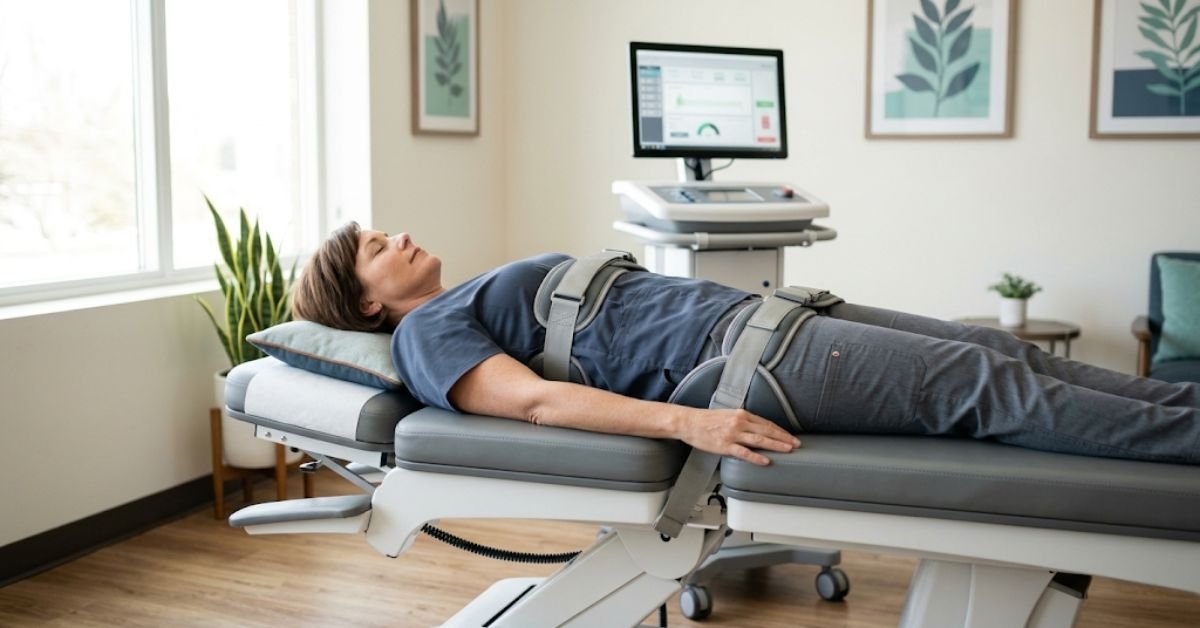
Spinal decompression uses a computer-controlled table to apply precisely calibrated, cyclical traction to a specific segment of your spine. Unlike simple manual traction or an inversion table, the decompression table can target a specific spinal level, apply the exact force appropriate for that patient, and cycle the tension in a pattern designed to avoid triggering the muscle guarding response that would counteract the stretch.
What that traction does at the disc level is create a small window of negative pressure inside the disc space. Under that negative pressure, herniated or bulging disc material can be pulled back toward its normal position, fluids and nutrients can be drawn into the disc to support healing, and pressure on nearby nerve roots can be relieved. This is the mechanism, controlled decompressive force producing measurable changes at the disc level.
The reason results build over multiple sessions is that a single session produces temporary changes. Repeated sessions, delivered close enough together over an adequate treatment course, produce cumulative changes that eventually stabilize. This is why one or two sessions rarely produce meaningful improvement, and why patients who stop early after “not feeling much difference” often miss the results they would have seen with a full protocol.
Success Rates by Condition
The most useful way to think about whether decompression will work for you is to look at the specific condition being treated. Success rates vary significantly by diagnosis, and honest expectations up front produce satisfied patients on the back end.
Contained Disc Herniation
Patients with contained lumbar or cervical disc herniations, where the disc material has bulged or herniated but has not fragmented, are the strongest candidates for decompression. Published research and clinical experience both show high response rates in this group, with meaningful pain reduction and functional improvement in the majority of patients who complete a full protocol.
Bulging Disc
Bulging discs, where the disc wall is stretched but not torn, respond well to decompression when they are the primary pain generator. The mechanism is direct: the negative pressure created during a session helps draw the bulge back toward its normal position and reduces mechanical pressure on nearby structures.
Disc-Related Sciatica
When sciatica is caused by a disc compressing a nerve root, decompression addresses the underlying cause and typically produces good results. When sciatica is caused by piriformis syndrome or other non-disc factors, decompression alone will not be the answer — this is why an accurate diagnosis matters before treatment starts.
Degenerative Disc Disease
Degenerative disc disease responds moderately to decompression. The treatment cannot reverse degeneration itself, but it can reduce pain, improve function, and take pressure off surrounding structures. Realistic expectations produce satisfied patients here.
Spinal Stenosis
Spinal stenosis responds moderately when disc involvement is contributing to the nerve compression. When stenosis is purely bony (arthritic overgrowth), decompression is less effective on its own but can still be part of a broader management approach.
Facet Joint Syndrome and Muscular Pain
Pain generated primarily by facet joints, muscle strain, or ligamentous injury is not what decompression is designed for. These patients respond better to chiropractic adjustment, soft tissue work, and rehabilitation. Treating these patients with decompression is where “it did not work” stories originate.
Why Some Patients Do Not Respond
Understanding why some patients do not get results is just as important as understanding why others do. The most common reasons for non-response fall into a small number of predictable patterns.
Wrong Diagnosis
The single most common cause of poor outcomes. When the pain generator is not what decompression treats, decompression will not fix it. This is a failure of evaluation, not a failure of the treatment itself.
Incomplete Treatment Course
Patients who stop after a handful of sessions because they “did not feel much difference” often stop right before results would have started to build. A full decompression protocol typically requires 20 to 28 sessions delivered over several weeks. Partial treatment produces partial results.
Missing Complementary Care
Decompression works best as part of an integrated care plan that includes adjustment, soft tissue work, and rehabilitation. Patients who receive decompression alone, without the supporting care, often see less durable results than patients who receive the full protocol.
Structural Problems Beyond Decompression’s Reach
Severe disc rupture with free fragments, significant spinal instability, cauda equina syndrome, or advanced structural pathology are conditions where surgery is genuinely the appropriate answer. Decompression will not fix these, and any provider who tells you otherwise is not being straight with you.
Not Actually a Candidate
Certain conditions make decompression contraindicated — significant osteoporosis, spinal fusion hardware at the treatment level, active infection, malignancy, pregnancy. Proper screening at the initial evaluation rules these out before treatment starts.
What Separates Real Decompression From Marketing Hype
Not all “spinal decompression” is the same, and this matters more than most patients realize when they are shopping providers.
Legitimate non-surgical spinal decompression is delivered on FDA-cleared decompression equipment that is computer-controlled, targets specific spinal levels, applies calibrated cyclical force, and monitors patient response throughout the session. The physician performing it has been trained specifically in decompression protocols, has selected you as an appropriate candidate through examination and imaging review, and integrates decompression with other appropriate care.
What is sometimes marketed as decompression, but is actually something different, includes simple mechanical traction on non-decompression equipment, gimmicky home devices sold with decompression claims, inversion tables (which apply gravity-based traction but cannot target specific spinal levels), and generalized traction protocols not tailored to the individual patient. These can have some limited benefit for some patients, but they are not the same treatment and should not be expected to produce the same results.
When you are evaluating a decompression provider, the questions worth asking are: what specific equipment is being used, what conditions is that equipment cleared to treat, how is candidacy determined, what does a typical treatment course involve, and how is progress measured. Providers who cannot answer these clearly are not the ones to trust with your spine.
Real Outcomes: What We See at Citrin
Our office has treated spinal decompression patients across the full spectrum of conditions for years, and the outcome patterns are consistent with what the research shows. Patients with disc-related pain who complete a full protocol typically see meaningful improvement, often substantial. Patients whose primary problem is not disc-related do not get the same results, which is why our examination process is aimed at ruling those patients out before treatment starts rather than after.
Some outcomes have been dramatic. Patients who came in walking with a cane and expecting surgery who returned to normal activity within months. Post-accident patients with persistent disc pain who avoided the surgical route entirely. Long-term back pain sufferers whose sciatica finally resolved after decades of intermittent flare-ups. These are not universal, and we do not promise them, but they happen often enough that we know decompression is capable of producing them for the right patients.
Other outcomes have been modest. Patients whose pain improved but did not resolve completely, who traded severe pain for manageable pain, or who improved during treatment but needed periodic maintenance care to hold their results. These are also real outcomes and, for patients living with chronic pain, still substantial quality-of-life improvements.
Occasionally, decompression does not produce the results a patient hoped for. When that happens, we are honest about it, we look at what else might help, and we do not keep patients in a protocol that is not working for them. This is the only defensible way to practice, and it is why we screen carefully before starting.
Is Decompression Right for You?
The only honest answer to that question comes from an actual examination. A proper decompression candidacy evaluation includes a detailed history of your symptoms, a thorough physical exam with orthopedic and neurological testing, review of any imaging you have, and, if imaging is needed to make the decision, a referral for MRI. From that, your physician can tell you honestly whether decompression is likely to help you, and if not, what would be a better path.
Our office serves patients across the St. Louis metro, including from Florissant, Clayton, Maryland Heights, University City, Ferguson, and beyond. Bilingual English and Spanish care is available at every visit. For patients whose pain originated with a car accident, our auto accident treatment approach integrates decompression with the full accident recovery plan, and the insurance coverage guide walks through how MedPay applies. For back or neck pain from other causes, our back pain treatment and neck pain care programs integrate decompression where it is genuinely the right tool.
Frequently Asked Questions
Does spinal decompression really work?
For appropriately selected patients, yes. Published research and clinical experience both show that non-surgical spinal decompression produces meaningful pain reduction and functional improvement in a substantial majority of patients with contained disc herniations, bulging discs, and disc-related sciatica. The critical qualifier is “appropriately selected,” which is why proper evaluation before treatment matters so much.
What is the success rate of spinal decompression?
Success rates vary by condition. Contained disc herniations and bulging discs tend to show the strongest response. Degenerative disc disease and stenosis show moderate response when disc involvement is present. Non-disc pain generators (facet syndrome, purely muscular pain, systemic conditions) do not respond well to decompression because those are not what it is designed to treat.
Is spinal decompression a scam?
No, but the way it is sometimes marketed can be misleading. Legitimate non-surgical spinal decompression uses FDA-cleared equipment, follows evidence-based protocols, and is delivered by trained physicians who evaluate candidacy before starting treatment. The negative online opinions typically come from patients who were treated with decompression when their condition was not something decompression addresses. That is a failure of patient selection, not a failure of the treatment itself.
How long before I see results from spinal decompression?
Most patients start noticing improvement within the first two to four weeks of a full protocol. Complete results typically build over the full 20 to 28 session course. Some patients feel dramatic relief early, others improve steadily throughout treatment. Judging results from just a handful of sessions is not enough to know whether it is working.
Why do some people say spinal decompression did not work for them?
Usually one of four reasons: they were not the right candidate for decompression to begin with, they stopped treatment before completing the full protocol, they received decompression without the complementary care (adjustment, soft tissue work, rehabilitation) that supports lasting results, or they had a structural problem beyond what decompression can address. Honest patient selection and complete treatment protocols largely eliminate these outcomes.
How is spinal decompression different from just traction or an inversion table?
Traction and inversion apply general stretching forces to the spine. Spinal decompression uses computer-controlled equipment to target specific spinal levels with calibrated, cyclical force that avoids triggering the muscle guarding response. The precision is what creates the negative pressure inside the disc space that produces the therapeutic effect. Simple traction and inversion cannot replicate this reliably.
Do I need imaging (MRI or X-ray) before spinal decompression?
You need enough diagnostic information to know whether decompression is the right treatment. In many cases X-rays, physical examination, and history are sufficient. In more complex cases, or when your physician needs to confirm a suspected disc issue, MRI is ordered. The point is not to require imaging for its own sake, but to make sure decompression is actually appropriate before starting.
Can spinal decompression make my condition worse?
Rarely, and typically only when patients are treated who should not have been candidates in the first place, or when appropriate force parameters are not used. Proper screening and evaluation at the outset, and adjustment of the protocol based on patient response, prevents this in the vast majority of cases. This is another reason the initial evaluation matters as much as the treatment itself.