
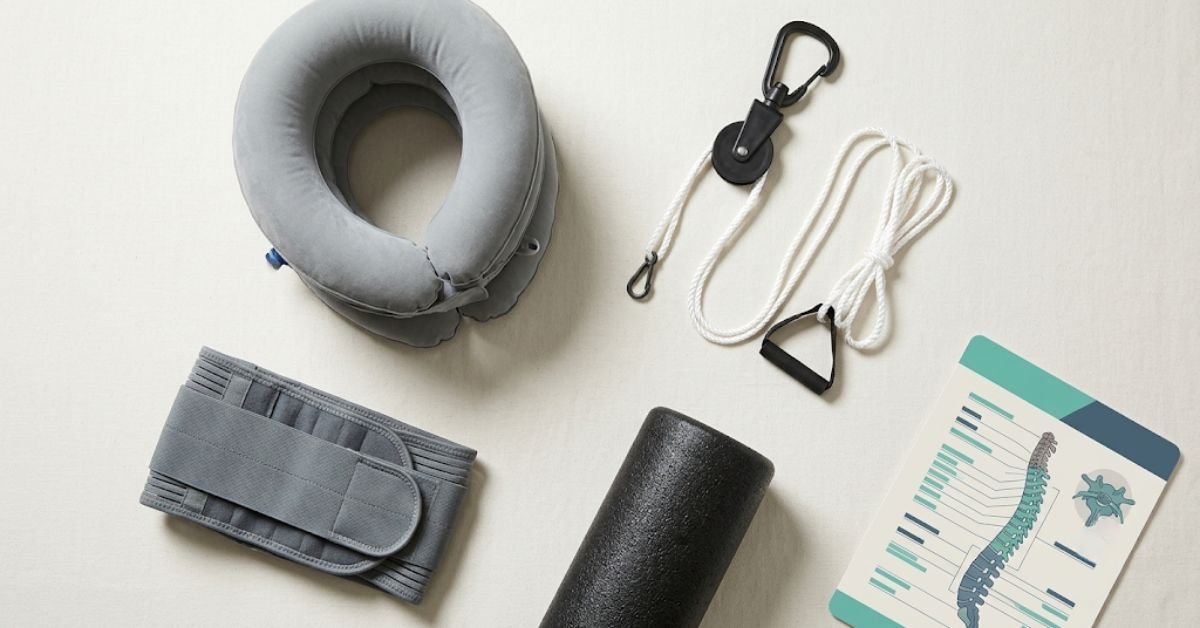
Search Amazon for “spinal decompression device” and you will get thousands of results. Cervical air bags that inflate around your neck. Lumbar belts that promise to “pull your discs apart.” Over-the-door traction contraptions. Inversion tables. Foam wedges. Suspension systems. Prices range from twenty dollars to several thousand, and the marketing on every one of them promises meaningful pain relief without ever setting foot in a clinic.
For a patient dealing with back or neck pain, the appeal is obvious. Home use is cheaper than professional treatment, more convenient, and lets you avoid the time commitment of a full clinical protocol. If a $60 device from Amazon can produce the results a professional decompression protocol promises, it would be foolish not to try that first.
The honest answer is that some home devices provide limited benefit for very mild issues, most produce far less than the marketing suggests, and a few can actively make certain conditions worse. At Citrin Chiropractic Center in St. Louis, we get asked about these devices constantly, and this article lays out what actually works, what does not, and why professional decompression is fundamentally a different intervention than anything you can do at home.
What Counts as “At-Home Spinal Decompression”?
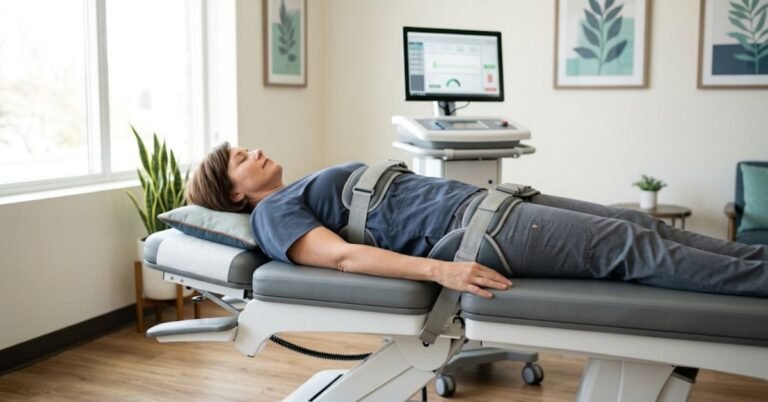
The phrase “spinal decompression” gets used broadly by home-device manufacturers, and the marketing rarely distinguishes between actual mechanical decompression and generic stretching. What the FDA-cleared professional decompression equipment does, computer-controlled cyclical traction targeting a specific spinal segment with calibrated force that avoids triggering the muscle guarding response, is genuinely not something home devices are capable of replicating. What most home devices actually do is provide gentle passive traction or postural stretching. Some of this can be modestly helpful. None of it is professional spinal decompression, regardless of what the box says.
Understanding this distinction matters because expecting a $60 device to produce the outcomes of professional decompression sets patients up for disappointment. What home devices can reasonably be expected to do is provide symptom relief for mild cases, help maintain gains from professional treatment, and offer between-session support. What they cannot do is reverse a herniated disc, resolve significant spinal problems, or replace clinical evaluation and care.
The Main Categories of At-Home Devices
Cervical (Neck) Traction Devices
Air-Pump Cervical Traction Collars
These inflatable devices wrap around the neck and expand vertically when pumped, creating gentle upward traction on the cervical spine. Popular brands run $30 to $80. For very mild neck stiffness or tension-type discomfort, they can provide modest short-term relief by reducing muscle tension. They cannot produce disc-level changes, and heavy or prolonged use can create excessive pressure on the jaw and mandible. Useful as a comfort tool for mild issues, not a treatment for actual cervical disc problems.
Over-Door Cervical Traction Kits
These use a weighted pulley system anchored to a door frame, with a head halter that applies traction to the neck. When used with the correct weight, angle, and duration, they can provide legitimate cervical traction. The problem is that most patients guess at all three parameters, and incorrect use ranges from ineffective to actively harmful. If a physician has evaluated your cervical condition and specifically prescribed home traction, these can supplement in-office care. Buying one online without professional guidance is not the same intervention.
Lumbar (Lower Back) Devices
Inflatable Lumbar Decompression Belts
Products like the DDS 500 and similar inflatable lumbar belts sell for $100 to $600 and promise “spinal decompression at home.” What they actually do is compress the abdomen while creating slight vertical lift, which can reduce the axial load on the lumbar spine when standing. This can provide comfort during activities of daily living for patients with mild disc issues, but calling it decompression is a stretch. Independent research on these devices is limited, and manufacturer studies tend to show modest benefit. Not harmful in most cases, but not a substitute for actual treatment.
Inversion Tables
Inversion tables tilt the user upside down (partially or fully) to use gravity to distract the spine. For appropriate patients, brief inversion can provide temporary symptom relief and, at meaningful angles, some passive decompression. The problems are that inversion is contraindicated for patients with high blood pressure, glaucoma, heart conditions, or eye issues; the traction is generalized (cannot target specific spinal levels); and prolonged use can produce dizziness, headaches, and eye pressure problems. Some patients find them useful as an adjunct, but they are not equivalent to targeted professional decompression.
Foam Rollers and Traction Blocks
Foam rollers and shaped lumbar traction blocks (patients lie on them for a few minutes) can provide gentle passive stretching and mild proprioceptive input. They are inexpensive, low-risk, and reasonably useful for general spinal mobility and muscle tension. They do not produce decompression in any clinical sense, but as a comfort and mobility tool they are inexpensive enough to be worth trying.
Body Weight Suspension Systems and Gravity Boots
Systems that suspend the user from their arms, or gravity boots that suspend by the ankles, apply significant traction using body weight. These can produce meaningful mechanical stretching of the spine, but they also produce meaningful risk when used without proper evaluation and guidance. Serious contraindications apply, and the traction is uncontrolled compared to professional equipment. Not something to use casually or without a physician’s specific input.
What the Research Actually Shows on Home Devices
Peer-reviewed research on home decompression devices is limited compared to the research on professional decompression equipment. What does exist tends to show a consistent pattern: home traction and passive stretching can produce modest short-term symptom relief for mild-to-moderate back and neck complaints, particularly when used as an adjunct to broader conservative care. Home devices as a standalone treatment for significant disc problems have not been shown to produce the structural changes that professional decompression produces.
The gap between marketing claims and research findings is the essential thing to understand. When a product claims to “reverse herniated discs at home” or to “produce the same results as clinical decompression at a fraction of the cost,” the marketing has moved well beyond what the evidence supports. Modest comfort tools are being sold as clinical treatments, and patients who make treatment decisions based on that marketing often delay actual care while their condition progresses.
The pattern to remember: home devices can complement care and provide modest relief for mild issues. They cannot replace clinical decompression for significant disc problems. Betting on a $60 device to fix a herniated disc typically wastes time that a real problem needed for treatment.
What Home Devices Can Do
- Provide short-term symptom relief for mild neck or back tension
- Help maintain gains from professional treatment between visits
- Support general spinal mobility and muscle tension
- Offer comfort during activities of daily living
- Give patients a sense of agency in their recovery
- Fill the gap between in-office visits when consistency is otherwise difficult
What Home Devices Cannot Do
- Produce the targeted, computer-controlled cyclical force that FDA-cleared decompression equipment produces
- Reverse a significant disc herniation or bulge
- Resolve sciatica caused by disc compression on a nerve root
- Address the biomechanical factors contributing to disc problems
- Diagnose what is actually causing your pain
- Provide the integrated care (adjustment, soft tissue work, rehabilitation) that produces durable results
- Replace clinical evaluation of a spinal problem
The Marketing vs Reality Gap
The most common claim in home-decompression marketing is that the device “produces the same results as professional decompression at a fraction of the cost.” This claim is not credible for several concrete reasons.
Professional decompression equipment costs a clinic tens of thousands of dollars because the engineering required to deliver controlled, cyclical, segment-specific force is genuinely complex. It is not economically possible for a $60 to $600 home device to replicate that engineering. What the home devices deliver is a much simpler intervention (gentle traction or postural stretching), which may or may not help depending on the underlying problem, but is not what professional decompression delivers.
Home devices also cannot provide the diagnostic evaluation that makes decompression effective. Professional treatment starts with an examination that determines whether decompression is even the right tool for your specific problem. Using a home device without that evaluation is a shot in the dark. If your pain is not actually being caused by something decompression addresses, no amount of home traction will help.
When Home Devices Are Appropriate
You have a confirmed mild condition, evaluated by a physician
If a chiropractor or other provider has evaluated your pain, given you a specific diagnosis, and recommended home traction or a specific device as part of your care, that recommendation is grounded in actual clinical judgment.
You are maintaining gains from professional treatment
After completing a full decompression protocol, an appropriate home device can help maintain results between maintenance visits. Your physician can guide you on which device makes sense for your specific case.
You have general muscle tension or postural discomfort, not a diagnosed spinal problem
For garden-variety tight muscles, tension, or general stiffness (not radiating pain, not numbness, not weakness), home tools like foam rollers or gentle traction devices are low-risk and often modestly helpful.
When Home Devices Are NOT Appropriate
You have not been evaluated by a physician
Back and neck pain has many possible causes, from muscular strain to disc herniation to structural problems to systemic conditions. Using a home device without knowing what is actually wrong is not a treatment strategy, it is a guess. Some of those guesses can make certain conditions worse.
You have radiating pain, numbness, weakness, or neurological symptoms
These are signs of nerve involvement that require proper evaluation. Home devices can occasionally provide temporary relief, but they will not address the underlying nerve compression, and the delay in getting appropriate care can allow the condition to progress.
You have any of the standard decompression contraindications
Osteoporosis, spinal fusion hardware, pregnancy, aortic aneurysm, spinal infection, malignancy, and severe cardiovascular conditions are all reasons professional decompression is not offered. The same conditions make home decompression devices inappropriate or dangerous.
Pain is severe, worsening, or has been present for weeks without improvement
Trying home devices in this scenario delays the evaluation and care that the situation actually needs. Every week of delay makes the underlying condition harder to fully resolve.
Safety Concerns Patients Do Not Consider
Home devices are generally low-risk when used appropriately by well-selected patients. Where safety problems arise is in three specific scenarios. First, use by patients with contraindications who did not know they had them (osteoporosis in older patients, undiagnosed hypertension for inversion tables, undiagnosed disc rupture, hardware from prior surgery). Second, use with excessive force, angle, or duration, patients frequently exceed manufacturer recommendations in an attempt to get better results. Third, use as a substitute for evaluation and care, allowing serious conditions to progress while home treatment fails to address them.
Actual injuries from home decompression devices are relatively uncommon but they do occur. More common is the opportunity cost, months spent on inadequate home care while the underlying problem progresses to a stage where professional treatment becomes more complex and takes longer.
Professional Decompression: What Makes It Different
| Feature | Home Devices | Professional Decompression |
|---|---|---|
| Force Control | Fixed or manually adjusted | Computer-controlled, cyclical, precise |
| Spinal Level Targeting | Generalized | Segment-specific |
| Muscle Guarding Response | Often triggered | Actively managed to avoid |
| Diagnostic Evaluation | None (you diagnose yourself) | Full clinical assessment |
| Integrated Care | None | Combined with adjustment, rehabilitation |
| Response Monitoring | You judge on your own | Adjusted based on clinical response |
| Suitable For | Mild issues, maintenance care | Significant disc problems, structured protocols |
The difference is not marketing. It is the difference between a general stretching tool and a targeted medical intervention. Both have their place. Neither substitutes for the other.
How to Think About Home Devices in Your Overall Care
The most useful way to think about home decompression devices is as complementary to, rather than replacement for, appropriate care. If your pain is mild and general, a low-cost home tool is reasonable to try. If it does not improve within a couple of weeks, that is a signal to get evaluated. If your pain is significant, radiating, worsening, or has been ongoing, skip the home devices and get evaluated first. Once you know what is actually wrong, you can decide whether professional treatment is warranted, and if so, whether an appropriate home device fits into the overall plan.
Our office often recommends specific home tools to patients as part of their overall care plan. What we do not recommend is patients spending months on home devices for problems that home devices are not designed to address. Time spent on inadequate self-treatment is time the underlying problem is progressing.
For patients whose disc problem stems from an auto accident, our auto accident treatment approach integrates professional decompression with the full accident recovery plan, and the insurance coverage guide walks through how MedPay applies. For general disc problems, our back pain and neck pain treatment programs integrate decompression with chiropractic adjustment and massage therapy for durable results. For deeper background on how professional decompression differs from generalized traction, see our overview of disc injury treatment.
Serving St. Louis and Surrounding Suburbs
Our office serves patients from across the St. Louis metro, including from Florissant, Clayton, Maryland Heights, University City, Ferguson, and beyond. Bilingual English and Spanish care is available at every visit.
Frequently Asked Questions
Do at-home spinal decompression devices actually work?
For mild issues and general muscle tension, some home devices provide modest short-term relief. For significant disc problems, herniated discs, or nerve-related symptoms, home devices cannot replicate what professional decompression delivers and typically do not resolve the underlying condition. The most honest answer is that they work for what they can work for, which is much less than most marketing suggests.
Can a home decompression belt fix a herniated disc?
No. Home decompression belts can reduce axial load on the spine and provide comfort during activities, but they do not produce the controlled, targeted force needed to reverse a disc herniation. Patients with actual disc herniations should get evaluated by a physician and consider professional decompression rather than relying on home devices.
Are inversion tables the same as spinal decompression?
No. Inversion tables use gravity to apply generalized traction to the entire spine, which is fundamentally different from targeted, computer-controlled decompression. Inversion tables can provide some benefit for appropriate patients but carry contraindications (high blood pressure, glaucoma, heart conditions) that make them inappropriate for many people. They are not equivalent to professional decompression.
Are home decompression devices safe?
Generally low-risk when used appropriately by patients without contraindications. Risk increases when patients have undiagnosed conditions (osteoporosis, disc rupture, aneurysm, hardware from prior surgery) that make traction inappropriate. The safest approach is to have a physician evaluate you before starting home traction, particularly if you have any radiating symptoms, weakness, or numbness.
Should I try home devices before spending money on professional decompression?
For very mild, general symptoms, trying a low-cost home tool is reasonable. For anything that involves radiating pain, numbness, weakness, or symptoms lasting more than a few weeks, a professional evaluation should come first. Knowing what is actually wrong is more valuable than trying random devices for months while the underlying problem progresses.
Which home decompression device is the best?
The most useful device is one that has been recommended for your specific case by a physician who has evaluated you. Absent that, low-cost general-purpose tools like foam rollers and gentle cervical traction devices are the safest to try for mild issues. Expensive devices making dramatic claims are usually not worth the cost.
Can I do professional-quality decompression at home?
No. The equipment required to deliver targeted, computer-controlled, cyclical decompression force is not economically or practically available for home use. What you can do at home is provide gentle traction, supportive stretching, and comfort measures, which is genuinely useful for some things and not equivalent to professional treatment for others.
What if a home device made my pain worse?
Stop using it and get evaluated. Home devices making pain worse usually means either the underlying condition was worse than the device is appropriate for, or the device was contraindicated for your specific situation. Continuing to use it hoping symptoms will improve is not a strategy that resolves the problem.