
The typical sciatica patient arrives at a specific crossroads. The pain that started as a dull ache in the lower back has traveled down through the buttock and into the leg, sometimes all the way to the foot. Ibuprofen has stopped working. Sitting is uncomfortable, sleeping is worse, and the primary care doctor has offered two options: an epidural steroid injection to reduce the inflammation, or a referral to a spine specialist who will consider surgery. What most patients are not told at this crossroads is that there is a third option, one that addresses the underlying cause of the sciatica rather than just the inflammatory response to it.
That third option is spinal decompression, and for the majority of sciatica cases (specifically those caused by disc compression on a nerve root, which is the most common cause) it deserves consideration before either injection or surgery is scheduled. The comparison to steroid injections in particular is worth laying out honestly, because injections are the most common medical intervention for sciatica and the one most patients are choosing between.
At Citrin Chiropractic Center in St. Louis, our physicians treat sciatica patients across the full range of severity, including many who have already had one or more injections that provided temporary relief before symptoms returned. What follows is an honest comparison of what each treatment actually does, what it produces, and when each is genuinely the right first choice.
Why Sciatica Gets Treated with Injections in the First Place
To understand why injections are so commonly prescribed, it helps to understand the medical model that produced them. Sciatica is nerve pain, and nerve pain is caused by inflammation and compression of a spinal nerve root. Steroid injections directly address the inflammatory component, delivering powerful anti-inflammatory medication (usually a corticosteroid, often mixed with a local anesthetic) into the epidural space near the affected nerve root. The medication reduces inflammation, which reduces pain, which the patient experiences as relief.
The appeal is obvious. Injections can produce meaningful relief within days to weeks of the procedure. They require a single visit rather than a treatment course. They are performed by pain management specialists who see them all day. For a patient in significant pain who wants relief now, the injection option is straightforward and often effective in the short term.
Where the injection approach falls short is in what it does not address: the mechanical cause of the inflammation. If a disc is compressing a nerve root, the injection reduces the inflammatory response to that compression but does not reduce the compression itself. Once the anti-inflammatory effect wears off (typically weeks to a few months), the underlying compression is still there, inflammation returns, and the pain comes back. This is why so many patients end up scheduling repeat injections, and why patients often arrive at our office having had two, three, or four injections that helped temporarily before symptoms recurred.
What Steroid Injections Actually Do (and Do Not Do)
What They Do
Steroid injections deliver targeted anti-inflammatory medication near the irritated nerve root. This reduces the inflammatory response, decreases swelling around the compressed nerve, and typically reduces pain within days to weeks. The relief can be substantial and, for some patients, is enough to allow other treatment (physical therapy, general activity) to be more effective. Injections are also useful diagnostically, if a targeted injection produces significant relief, it confirms that the injected nerve root is the source of the pain.
What They Do Not Do
Injections do not address the underlying cause of the nerve compression. If a herniated disc is pressing on the nerve, the disc is still herniated after the injection. If disc degeneration is producing chronic nerve irritation, the degeneration continues after the injection. The relief comes from suppressing the inflammatory response, not from correcting the mechanical problem. This is why the relief is typically time-limited, when the anti-inflammatory effect wears off, the underlying cause reasserts itself.
The Cumulative Limitation
Most pain management practices limit patients to three or four epidural steroid injections per year, and typically no more than a lifetime cap of six to ten. This is because repeated corticosteroid exposure has real cumulative effects, weakening of the surrounding bone and connective tissue, potential impact on adrenal function, and diminishing effectiveness with each subsequent injection. Patients whose sciatica keeps returning cannot simply keep receiving injections indefinitely.
What Spinal Decompression Does Differently
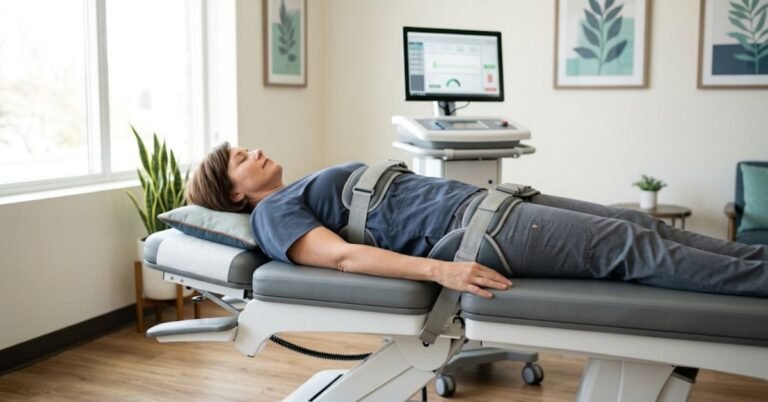
Spinal decompression takes a fundamentally different approach to sciatica. Instead of suppressing the inflammatory response to nerve compression, decompression addresses the mechanical cause of the compression itself. Controlled cyclical traction applied to the affected spinal segment creates negative pressure inside the disc space, drawing herniated or bulging material back toward its normal position and reducing pressure on the nerve root. Over the full treatment protocol, the mechanical problem that has been generating the inflammation begins to resolve.
Because decompression addresses the cause rather than just the symptom, the results tend to be more durable when they occur. Patients who complete a full protocol with good response often go years without recurrence, whereas patients who rely on injections typically need repeat procedures as the underlying condition remains unaddressed. This difference, addressing cause versus suppressing symptoms, is the essential distinction between the two approaches.
The pattern to remember: steroid injections treat the inflammation. Spinal decompression treats the compression producing the inflammation. Both can help sciatica, but they are doing fundamentally different things, and the durability of results reflects that difference.
Head-to-Head: The Comparison That Matters
Spinal Decompression
- Addresses mechanical cause (disc compression)
- Non-invasive, no needle, no anesthesia
- No cumulative use limits
- Results build over 4–8 weeks
- Durable relief when it works
- Integrates with adjustment, rehabilitation
Epidural Steroid Injection
- Addresses inflammatory response (not the cause)
- Invasive procedure with needle placement
- Limited to 3–4 per year, lifetime cap common
- Relief typically felt within days to weeks
- Temporary relief, often weeks to months
- Standalone procedure, not integrated care
| Factor | Spinal Decompression | Epidural Steroid Injection |
|---|---|---|
| Typical Cost (before insurance) | $2,500 – $6,000 for full protocol | $300 – $3,000 per injection |
| Number of Sessions/Procedures | 20–28 sessions over 4–8 weeks | 1–3 injections spaced weeks apart |
| Time to First Relief | Often 2–4 weeks into protocol | Days to 1–2 weeks after injection |
| Duration of Relief | Long-term when successful (years) | Weeks to months, often requires repeat |
| Risks | Minimal for appropriate candidates | Infection, dural puncture, nerve damage (rare), cumulative steroid effects |
| Cumulative Use Limits | None | 3–4 per year typical; lifetime caps |
| Addresses Root Cause | Yes (mechanical compression) | No (treats inflammation only) |
| Recovery Time | None (return to normal same day) | 24-48 hours limited activity typical |
Success Rates: What the Evidence Shows
Steroid Injections for Sciatica
Published research on epidural steroid injections for sciatica shows meaningful short-term pain relief in the majority of appropriately selected patients, typically in the 50 to 70 percent range for the first weeks to months following injection. Longer-term outcomes are less impressive, at six to twelve months post-injection, the difference between injected patients and untreated patients often narrows substantially. Repeat injections extend the relief window but with the cumulative use limits noted above.
Spinal Decompression for Sciatica
Published research on non-surgical spinal decompression for disc-related sciatica shows meaningful pain reduction and functional improvement in the majority of appropriately selected patients who complete a full protocol. The specific advantage of decompression is durability, patients who respond and complete treatment tend to maintain their improvements for years rather than months. The specific limitation is that patients whose sciatica is not caused by disc compression (piriformis syndrome, spinal stenosis without disc involvement) do not respond to decompression alone.
The Combined Approach
Some patients benefit from both interventions used sequentially. A steroid injection can provide the immediate relief that makes a patient functional enough to complete a decompression protocol, while the decompression addresses the underlying cause. In these cases, the injection is used tactically rather than as the primary treatment plan.
When Injections Are Genuinely the Right Choice
This article is not anti-injection. Steroid injections have legitimate indications and produce meaningful benefit for the right patients. Situations where injections are appropriately the right first choice include: severe acute sciatica that is preventing all functional activity, where fast relief is essential; sciatica with significant inflammatory component from a specific triggering event; patients who need diagnostic clarification about which nerve root is the pain generator; patients who cannot tolerate the time commitment of a decompression protocol; and patients who have completed conservative care and need targeted symptomatic relief before further treatment decisions.
When Decompression Should Be Tried First
For patients whose sciatica traces to disc compression on a nerve root, and whose situation allows for the four-to-eight week treatment protocol, decompression deserves consideration before injection. Specific patient profiles where decompression is often the better first step include: patients whose sciatica has been present for weeks or months without acute crisis; patients who have had prior injections that provided temporary relief before symptoms recurred; patients concerned about the cumulative effects of repeated steroid exposure; patients who want to address the underlying condition rather than just manage symptoms; and patients who have been told to consider surgery but want to try reversible options first.
The Sciatica Cases Where Neither Works Alone
Not every sciatica case has a straightforward answer. Certain presentations require more than injection alone or decompression alone, and being honest about them matters.
Piriformis Syndrome
When the sciatic nerve is being compressed by the piriformis muscle in the buttock rather than by a disc in the lumbar spine, neither an epidural injection nor spinal decompression addresses the actual source. These cases respond better to targeted soft tissue work, medical massage therapy, specific stretching, and often chiropractic adjustment of the pelvis.
Spinal Stenosis Without Disc Involvement
Sciatica caused by bony arthritic narrowing of the spinal canal, without significant disc involvement, responds less well to decompression alone. Injections may provide temporary relief, but neither addresses the underlying stenosis. These cases often benefit from a broader conservative approach and, in severe cases, may eventually require surgical evaluation.
Severe Disc Rupture with Free Fragments
When disc material has fragmented and migrated into the spinal canal, non-surgical decompression cannot draw fragmented material back into place. Injections can provide temporary inflammation control, but surgical removal of the fragments may be the appropriate treatment.
Progressive Neurological Deficits
Sciatica accompanied by progressive weakness, worsening numbness, or bowel or bladder changes requires surgical evaluation regardless of what conservative options are available. These are red flags that indicate the underlying condition is progressing to a stage where conservative care alone is not appropriate.
What the Sciatica Decompression Protocol Looks Like at Citrin
For patients whose sciatica is a good candidate for decompression, the treatment approach at our office follows a consistent structure. The initial evaluation determines whether disc compression is genuinely the cause of the pain (versus piriformis or other sources), rules out contraindications, and confirms the specific spinal level or levels involved. The active protocol typically runs 20 to 28 sessions of decompression over four to eight weeks, integrated with chiropractic adjustment to restore proper motion to affected spinal segments, soft tissue work to address the muscle guarding that develops around the injured segment, and progressive rehabilitation to strengthen the supporting musculature.
Radiating leg pain typically follows a predictable retreat pattern during treatment, first shrinking in territory (pain that used to travel to the foot may retreat to the calf, then to the knee, then to the buttock) before resolving completely. The territorial pattern is one of the most reliable early indicators that treatment is working. Substantial improvement is often clear by sessions ten to fifteen, with complete resolution typically arriving in the second half of the protocol.
Patients whose sciatica came from an auto accident receive integrated care through our auto accident treatment approach, with MedPay coverage typically paying for the full protocol as detailed in the insurance coverage guide. For patients whose sciatica traces to other causes, our sciatica treatment approach and back pain treatment integrate decompression with the full clinical picture. Related work on disc injuries and post-treatment maintenance care is coordinated through the same team.
Serving St. Louis and Surrounding Suburbs
Our office serves sciatica patients from across the St. Louis metro, including from Florissant, Clayton, Maryland Heights, University City, Ferguson, and beyond. Bilingual English and Spanish care is available at every visit. Same-day appointments are standard for new patient evaluations.
Frequently Asked Questions
Does spinal decompression work for sciatica?
For sciatica caused by disc compression on a nerve root, yes, in the majority of appropriately selected patients who complete a full protocol. Sciatica caused by piriformis syndrome or bony spinal stenosis without disc involvement does not respond as well to decompression alone. An accurate diagnosis before treatment starts determines which category your specific case falls into.
Should I try a cortisone shot or spinal decompression for sciatica first?
It depends on your specific situation. For severe acute sciatica preventing all functional activity, an injection can provide the fast relief needed to become functional. For sciatica that has been present for weeks or months, or for patients who have had prior injections that helped only temporarily, decompression addresses the underlying cause rather than just the inflammation and often produces more durable results.
Do epidural steroid injections actually work for sciatica?
They produce meaningful short-term pain relief in the majority of patients, typically in the 50 to 70 percent range in the weeks to months following injection. Longer-term outcomes are less impressive because injections address the inflammatory response to nerve compression rather than the compression itself. Repeat injections extend relief but with cumulative use limits.
Can I get spinal decompression if I already had steroid injections?
Yes. Prior injections do not preclude decompression treatment, and many of our decompression patients have had one or more injections previously. The main consideration is spacing, we typically allow appropriate time after an injection before starting decompression, and coordinate the timing with your pain management specialist.
How much does spinal decompression for sciatica cost compared to injections?
A full decompression protocol typically costs $2,500 to $6,000. A single epidural steroid injection costs $300 to $3,000. Patients frequently need multiple injections, and the cumulative cost of repeated injections over time often exceeds the one-time cost of a full decompression protocol, particularly when the decompression produces durable relief that eliminates the need for further intervention.
Which has fewer side effects, decompression or injections?
Decompression has a substantially lower risk profile. Injections carry small but real risks including infection, dural puncture, nerve damage, and cumulative corticosteroid effects on bone and adrenal function. Decompression, for appropriate candidates without contraindications, has minimal risk beyond mild transient soreness in the early sessions.
How long does relief last after decompression compared to injections?
Injection relief typically lasts weeks to a few months before symptoms return. Decompression relief, when the treatment successfully addresses the underlying cause, is typically durable for years. This difference reflects that injections manage symptoms while decompression addresses the mechanical problem producing them.
Can I do both spinal decompression and injections?
Yes, and some patients benefit from the combination. An injection can provide the immediate relief needed to become functional enough to complete a decompression protocol, while the decompression addresses the underlying disc problem. In these cases, the injection is used tactically rather than as the primary treatment plan. Coordination between your pain management specialist and our office allows this combined approach to be sequenced appropriately.